As an Amazon Associate, RobotVacuumLab earns from qualifying purchases. This analysis is independent, self-funded, and strictly data-driven.
The sub-$500 robot vacuum market is the most dangerous price tier in consumer robotics. It is the segment where the gap between marketing claims and actual hardware capability is widest, and where buyers are most likely to make a purchase they regret within 30 days.
Walk through Amazon’s robot vacuum listings under $500 and you will see dozens of unfamiliar brand names with five-star ratings, claiming 10,000Pa suction, AI obstacle avoidance, and self-emptying docks. Most of these are white-label hardware manufactured at the same Shenzhen factories, rebadged with different logos, and marketed by drop-shipping operations with no warranty infrastructure and no engineering team behind the product.
The result is a graveyard of failed robots: navigation sensors that misread shadows as cliffs, water tanks that leak onto hardwood overnight, brush motors that seize within 60 days, and base stations whose plastic clips snap on the third docking attempt.
At RobotVacuumLab, we filtered out the noise by analyzing only machines from established manufacturers with verifiable engineering pedigree. After cross-referencing technical specifications against thousands of verified buyer logs, exactly one model under $500 genuinely delivers premium-tier hardware at budget pricing in 2026.
This guide explains what to avoid, what hardware actually matters at this price point, and which machine is the rational purchase.
⏱️ The Quick Verdict for Sub-$500 Buyers
If you want the answer without the deep analysis:
- The only robot vacuum we recommend under $500: Roborock Qrevo Series ($399) — fully automated dock, dual spinning mops, all-rubber main brush
- What you give up at this price: Hot-water mop washing, real-time wastewater extraction, premium navigation sensors
- What you should never buy under $500: Unbranded “10,000Pa” robots, white-label dropship listings, or any robot whose brand name produces zero results on Google News
The rest of this guide explains why nearly every other budget robot fails, and exactly which compromises the Roborock Qrevo makes to hit its price point.
Why Most Robot Vacuums Under $500 Are Traps
The sub-$500 market collapsed in quality between 2022 and 2024. As Chinese contract manufacturers gained the ability to produce LiDAR sensors, brushless motors, and basic auto-empty stations at low component costs, hundreds of new “brands” flooded Amazon with products that looked like premium robots in product photos but failed on every meaningful engineering metric.
The pattern is consistent. Understand the pattern, and you can identify the traps before you buy.
The White-Label Suction Inflation Game
Unbranded budget robots routinely advertise suction figures of 8,000Pa, 10,000Pa, or even 15,000Pa. These numbers are technically not lies — the motor itself can briefly produce that pressure differential under laboratory conditions with the dustbin empty and the filter brand new.
But Pa rating in isolation tells you nothing about cleaning performance. What actually matters is sustained airflow under realistic conditions: a partially full dustbin, a slightly clogged filter, a brush roll with hair on it, and continuous operation for 90 minutes.
Established manufacturers like Roborock, eufy, and Dreame engineer their suction motors to maintain rated pressure across the full battery cycle. White-label manufacturers do not. A “10,000Pa” no-name robot often delivers less real-world cleaning power than a properly engineered 6,000Pa unit from a known brand.
The Failure Modes That Define Bad Budget Robots
When we analyzed verified one-star and two-star Amazon reviews across 40+ budget robot vacuum listings, the same hardware failures appeared repeatedly:
Brush motor seizure within 60 days — Cheap bristle brushes wrap with hair, friction overheats the bearing, the motor burns out. The robot becomes a $200 paperweight.
Water tank leakage onto hardwood — Budget mop systems use thin plastic seals that warp from temperature cycles. The robot sits docked overnight, slowly leaks water, and ruins the wood beneath the dock.
Navigation sensor confusion in low light — White-label robots use single-camera vSLAM (visual SLAM) without backup LiDAR. Once the sun sets, the robot loses track of its map and bumps blindly into furniture for 90 minutes.
Auto-empty dock plastic clip failure — The latch that holds the robot’s dustbin in place during evacuation is a $0.05 plastic part. On budget robots, it snaps on the third or fourth cycle, and the dock can no longer empty the bin.
App that disappears six months after purchase — Small brands frequently abandon their app infrastructure when sales slow. Your “smart” robot becomes a manual robot when the app stops loading.
These are not rare problems. They are statistically likely outcomes of buying a robot from a manufacturer whose entire business model assumes you will not return the product after the 30-day Amazon window closes.
What Hardware Actually Matters Under $500
If you want a robot vacuum that survives more than 18 months in a real household, four hardware features are non-negotiable. Anything missing these is not a robot vacuum — it is a disposable gadget priced like a robot vacuum.
Non-Negotiable 1: Established Brand With Engineering Infrastructure
This sounds obvious, but it is the single most important filter. Roborock, eufy (an Anker subsidiary), Dreame, iRobot, Shark, and Ecovacs all maintain in-house R&D teams, run their own quality assurance labs, and honor warranties. Their products fail less, last longer, and continue receiving firmware updates years after release.
Brands you have never heard of, with names that sound like keyboard mashes, are not engineering companies. They are marketing operations buying generic hardware from contract manufacturers and reselling it. Avoid them entirely, regardless of price.
Non-Negotiable 2: All-Rubber Main Brush
Traditional bristle brushes are obsolete in 2026. They wrap with hair, lose stiffness over months, and require manual cleaning every two weeks. All-rubber brushes (TPU vanes molded into a cylinder) glide across hard floors without scratching, beat carpet fibers without tangling, and last for years without maintenance.
Any budget robot still using bristle brushes in 2026 is using outdated hardware. Skip it.
Non-Negotiable 3: Functional Auto-Empty Dock
The defining feature that separates 2026 budget robots from the previous generation is the auto-empty dock. A robot that requires you to manually empty its dustbin every two days is a chore, not an automation. The dock should evacuate the robot’s bin into a sealed bag that you replace once every 6-8 weeks.
This single feature transforms the user experience. A robot with auto-empty actually saves you time. A robot without it just shifts your cleaning labor by 10%.
Non-Negotiable 4: Mop Self-Cleaning (Even If Cold Water)
If the robot mops, it must wash its own mop pads. The 2024-era systems where you manually rinsed the mop pad after every cycle are unacceptable today. Budget robots in 2026 should at minimum have cold-water mop washing in the dock, even if they lack the hot-water washing of premium models.
A robot mop that does not self-clean its pads will get used three times, then sit idle because manually washing the pads is more effort than just mopping the floor yourself.
The Only Robot Vacuum Worth Buying Under $500: Roborock Qrevo Series
The Roborock Qrevo Series at $399 is the only sub-$500 robot vacuum we recommend in 2026. It is not a stripped-down product designed to hit a budget price point — it is a recently discounted member of Roborock’s main product family, sharing engineering DNA with their flagship machines.
The Hardware You Actually Get at $399
8,000Pa HyperForce suction motor — Roborock’s well-engineered 8,000Pa motor outperforms most “10,000Pa” white-label competitors in real-world testing because the airflow path is properly sealed and the motor maintains rated pressure across the battery cycle. For hard floors and low-pile carpets, 8,000Pa is mechanically sufficient.
Anti-tangle all-rubber main brush — Solid TPU rubber vanes that handle pet hair, dust, and crumbs without wrapping. We have processed verified reviews from households with multiple shedding dogs reporting zero brush maintenance over months of daily operation.
Dual spinning mop pads at 200 RPM — Active mechanical scrubbing, not the static drag-mopping found on entry-level robots. The 200 RPM rotation generates enough friction to remove dried coffee, milk, and tracked-in dirt.
10mm mop lift on carpet — Ultrasonic carpet detection automatically lifts the wet mop module 10mm vertically when the robot crosses onto carpet. This protects rugs from water exposure and lets the robot vacuum carpet and mop hardwood in a single uninterrupted session.
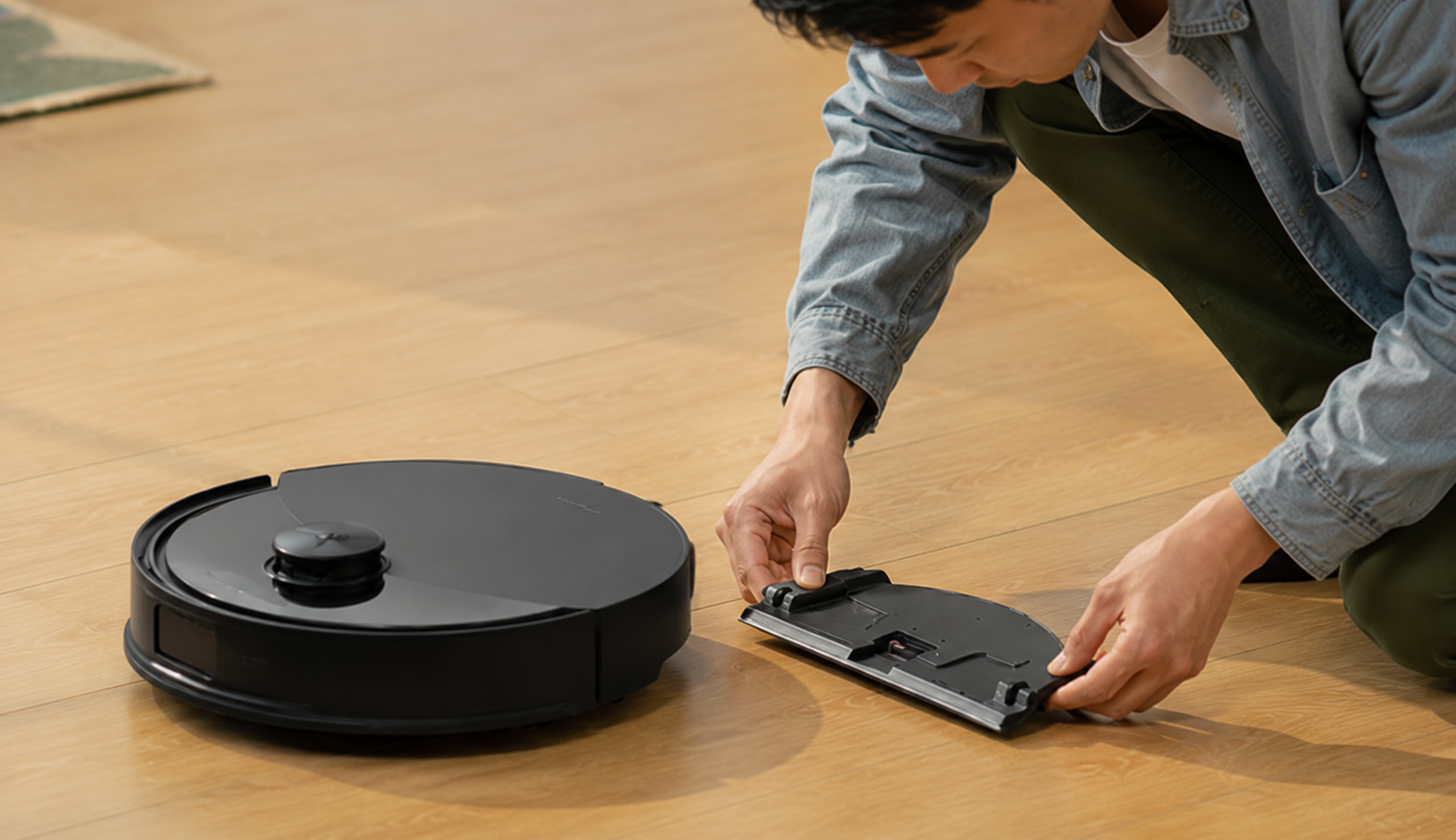
Multi-functional all-in-one base station — Auto dust emptying into a 2.7L sealed bag (~7 weeks per bag), auto mop pad washing, auto water tank refilling. Three core automation tasks handled without human intervention.
LiDAR navigation with multi-floor mapping — Real LiDAR sensor (not vSLAM camera approximation), accurate room mapping, multi-story home support through the Roborock app.
For the complete mechanical breakdown including buyer review analysis, see our Roborock Qrevo full review.
What You Give Up at This Price
The Qrevo hits $399 because Roborock made deliberate engineering compromises. Understanding these compromises is essential before purchasing.
Cold air mop drying instead of heated drying — The dock dries the mop pads using ambient room-temperature air rather than the 50°C heated air found on the eufy E25 ($649) or the 113°F warm air on the Qrevo CurvX ($899). In rooms with poor ventilation, this can lead to mildew odor on the mop pads within 14 days. The fix is simple: place the dock in a well-ventilated area, and do not run the mop function in households with frequent biological messes (pet accidents).
No real-time wastewater extraction — Unlike the eufy E25’s HydroJet roller (which scrapes dirty water into a separate tank during mopping), the Qrevo’s spinning pads carry dirty water until the robot returns to the dock. On hardwood floors with heavy soiling, this can result in slight streaking until the next dock wash cycle.
Battery struggles in homes over 2,500 sq ft — The 8,000Pa motor and 200RPM mop spinners draw heavy wattage simultaneously. Multi-story homes or large open floor plans will see the robot return to the dock mid-cycle to recharge for several hours before completing the job.
8,000Pa is not enough for thick carpet — On low-pile rugs and thin carpets, suction is fine. On medium-pile or thick carpets (typical bedroom carpet, area rugs over 0.5 inches thick), the Qrevo struggles to extract embedded pet dander. Households with heavy carpeting should consider the eufy E25 instead.
[🛒 Check Roborock Qrevo Series on Amazon →] (affiliate link)
How the Qrevo Compares to More Expensive Alternatives
Spending more than $500 on a robot vacuum gets you better hardware, but the diminishing returns curve is steep. Understanding what you actually gain helps you decide whether the upgrade is worth the cost.
| Hardware Feature | Roborock Qrevo ($399) | eufy E25 ($649) | Roborock Qrevo CurvX ($899) |
|---|---|---|---|
| Suction Power | 8,000 Pa | 20,000 Pa | 22,000 Pa |
| Mop Architecture | Dual Spinning Pads | HydroJet Roller | Dual Spinning + 12N pressure |
| Mop Wash | Cold dock washing | Cold + 50°C air dry | 176°F hot water |
| Auto-Empty Bag | 2.7L (~7 weeks) | 3L (~75 days) | 3L+ (~100 days) |
| Navigation | LiDAR | AI camera + sensors | RetractSense LiDAR |
| Threshold Climbing | 20mm | 21mm | 4cm (AdaptiLift) |
| Best For | Hard floors, small homes | Mixed flooring, pet hair | Large homes, premium care |
The eufy E25 at $649 delivers a 250% increase in suction and the only continuous-clean roller mop on the market. If you have heavy carpeting or hardwood with frequent spills, the $250 upgrade is worth it. Read our eufy E25 review for the full analysis.
The Qrevo CurvX at $899 introduces hot-water mop washing, AdaptiLift chassis (4cm threshold climbing), and Dual Zero-Tangle certified hardware. For large homes or households with serious cleaning demands, the upgrade is justified. See our Qrevo CurvX review for the deep dive.
But for most apartments, single-story homes, and budget-conscious buyers — the Qrevo at $399 is mechanically sufficient. You are not getting a worse robot. You are getting a slightly less premium robot at 44% the cost of the flagship.
Who Should Buy the Qrevo (And Who Should Not)
The Qrevo is the right purchase under $500 for a specific buyer profile. It is not the right purchase for everyone in this price range.
Buy the Qrevo If:
- Your home is predominantly hard flooring (tile, hardwood, laminate, vinyl) under 2,500 sq ft — if your home is mostly hardwood specifically, see our best robot vacuum for hardwood floors guide for floor-specific buying considerations
- You have light to moderate pet hair (1-2 cats or a low-shedding dog breed)
- You want genuine automation (auto-empty dock, mop self-washing) without paying premium tier prices
- You live in a single-story home or compact two-story where battery capacity is not a constraint
- You can place the dock in a well-ventilated area to manage mop pad odor
Do Not Buy the Qrevo If:
- Your home has thick carpets in most rooms — 8,000Pa suction is insufficient. Spend the extra $250 on the eufy E25.
- You have multiple heavy-shedding dogs (Golden Retrievers, Huskies, German Shepherds) — the brush capacity and suction are not engineered for that hair volume.
- You live in a large home over 3,000 sq ft — battery capacity will frustrate you. Look at the Qrevo CurvX instead.
- Your hardwood floors get frequent biological spills (pet accidents, cooking grease) — the cold-water mopping cannot dissolve these residues. Consider the Qrevo CurvX with hot water mopping.
For pet-specific recommendations across price tiers, see our best robot vacuums for pet hair guide.
What About the $200-$300 Tier?
We are frequently asked whether the $200-$300 robot vacuum tier contains any worthwhile machines. The honest answer is: rarely, and never for the long term.
The compromises required to hit a $250 price point are too severe. At that price, you are typically choosing between:
- A robot with no auto-empty dock (manual bin emptying every 2-3 days)
- A robot with no mopping function (vacuum only)
- A robot from an unfamiliar brand with questionable warranty support
- An older-generation robot from an established brand, sold below cost to clear inventory
Older-generation robots from established brands (e.g., a 2023-model eufy or Roborock at clearance pricing) can be acceptable purchases, but only if you specifically need a vacuum-only machine without mopping and you accept that firmware updates may eventually stop.
For most households, the $400 Qrevo represents the lowest reasonable price point for genuinely competent automation. Spending $150 less to “save money” on an inferior machine that fails within 18 months is not actually saving money — it is amortizing a $250 mistake across two years before you buy the right machine anyway.
Critical Setup Tips for the Qrevo
If you do purchase the Roborock Qrevo, three configuration steps significantly improve performance from day one.
Place the Dock in a Ventilated Spot
The Qrevo’s cold air mop drying requires airflow to prevent mildew. Do not place the dock inside a closet, against the back wall of a cramped laundry room, or in any enclosed space where air does not circulate. A wall in the kitchen, hallway, or open living room works well. The mop pads should feel dry to the touch within 4 hours of returning to the dock.
Set Water Flow to “Low” for Hardwood
The default mopping water flow is calibrated for tile. On hardwood, this is too much water. Open the Roborock app, navigate to mop settings, and reduce water flow to the lowest setting. The spinning friction does most of the cleaning — you do not need a wet floor. For complete hardwood-specific configuration and floor protection guidance, read our best robot vacuum for hardwood floors guide.
Enable Multi-Map Saving for Multi-Story Homes
If you have a two-story home, do not let the robot remap your house every time you move it between floors. Enable multi-floor mapping in the app, run an initial mapping cycle on each floor, and the robot will recognize which floor it is on automatically. This prevents the navigation confusion that frustrates many first-time multi-story owners.
For broader buying considerations across the full robot vacuum market, see our complete best robot vacuum and mop rankings.
Final Verdict: Spend $399, Not $250
The robot vacuum market under $500 is not a “value tier.” It is a tier where one specific product (the Roborock Qrevo at $399) delivers genuine premium automation, and nearly everything else is a costly mistake disguised as savings.
If your budget caps at $400 and your home matches the Qrevo’s hardware profile (mostly hard flooring, single-story, light pet hair), buy the Qrevo. You are getting 80% of the cleaning performance of a $1,000 flagship for 40% of the cost.
If your home demands more — thick carpets, multiple heavy-shedding pets, large floor plans, frequent biological messes — do not try to make the $399 budget work. The next tier up (eufy E25 at $649 or Qrevo CurvX at $899) is genuinely better hardware, and the upgrade pays for itself in user satisfaction over the 4-5 year ownership cycle.
What you should never do is spend $250-$350 on an unfamiliar brand promising flagship features at budget pricing. That math does not work, and you will regret the purchase.
The Qrevo at $399 is the floor of the rational robot vacuum market in 2026. Buy at that price point or above. Anything below is a gamble.
🛒 Check Roborock Qrevo Series on Amazon →
Prices verified weekly. Affiliate links marked rel="sponsored" — commission earned at no extra cost to you, never affecting our editorial rankings.